
.jpg?cx=0.5&cy=0.5&cw=150&ch=120&blr=False&hash=32CFC9647F516D159375559BB5C39EFD)


.jpg?cx=0.490000009536743&cy=0.540000021457672&cw=150&ch=120&blr=False&hash=93ED4F6DFD0EB29BB2E466E6DDD7C794)













Does Your Skin Feel Overwhelmed? A Skincare Reset May Help Support Its Natural State
September 21, 2026

Why Does Skin Feel Overwhelmed by a Skincare Routine?
A skincare reset is a strategic move: scale back overlapping products and actives to reduce stress on your skin, making it easier to identify needs and sensitivities (supporting skin comfort). Remember, a reset is not about using only water, stopping prescribed treatments, or adding harsh procedures—it’s about essentials and patience.
Signs Your Skin May Feel Overwhelmed and Need Support
Notice a combination of tightness, dryness, flakiness, redness, unexpected congestion, or sudden oiliness—especially after increasing product layering or switching up your routine? While not always definitive of barrier damage, these signs suggest your current routine may be too complex.
If Your Skin Feels This Way, What Should You Change?
When your skin is feeling “out of whack,” overly dry, tight, or you’re noticing flakiness or redness, Jane Yoo, board-certified dermatologist & Mohs surgeon in Midtown Manhattan, recommends striping the routine down immediately. “Stop retinoids, exfoliating acids, and physical scrubs first—those are the most common culprits,” Dr. Yoo says. “Vitamin C and other actives come off next if there's still irritation. What's left should be: a gentle non-foaming cleanser, a ceramide-based moisturizer, and mineral sunscreen. That's it. Give the barrier 2–4 weeks on that minimal routine before reintroducing anything active, and add back one product at a time."
| If skin feels... | Possible routine issue | Barrier-first reset response |
| Tight, dry, or flaky | Overexfoliation, harsh cleansing, moisture deficit | Pause exfoliants; use a gentle cleanser; opt for a rich moisturizer. |
| Stinging, red, or reactive | Too many actives, fragrance, or harsh combos | Stop unnecessary actives; focus on gentle cleansing, moisturizer, SPF. |
| Congested | Product overlap/heavy layering/rapid switching | Reduce variables; reintroduce products gradually. |
| Oilier than usual | Over-cleansing, lack of hydration, frequent switching | Prioritize gentle cleanse and consistent moisturizer before adding oil-control. |
Common Routine Triggers to Scale Back During a Reset
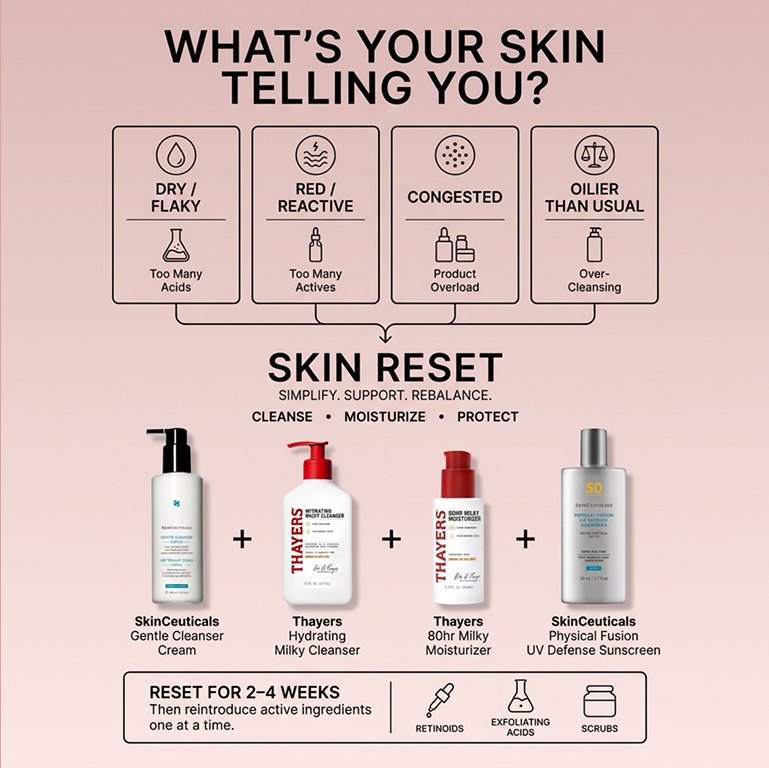
Pare back strong actives (retinoids, exfoliating acids), fragrances, aggressive exfoliation, and rapid product changes. These are common triggers for temporary sensitivity or reactivity—even if you don’t have “sensitive skin.”
What Should You Keep in a Skincare Reset Routine?
Build your reset with three essentials:
- Morning: Rinse or cleanse as needed, apply moisturizer, finish with a broad-spectrum sunscreen.
- Evening: Cleanse gently (especially to remove makeup/SPF), then moisturize. Serums, essences, exfoliants, and tools are optional—not required—during this phase.
Step 1: Gentle Cleansing
Opt for a single, gentle cream or milky cleanser (like SkinCeuticals Gentle Cleanser or Thayers Milky Cleanser) that doesn’t strip skin. If you’re wearing heavy makeup or SPF, consider a makeup remover before your main cleanse. Stripping the skin or over-cleansing can further damage the lipid matrix and increase transepidermal water loss (TEWL).
Step 2: Hydration and Barrier Support
Immediately after cleansing, apply a single moisturizer matched to your skin’s needs and climate. Products like Thayers Milky Moisturizer are formulated with barrier-supporting ingredients (ceramides, hyaluronic acid) AND help retain hydration and support natural moisturizing factor (NMF) balance.
Step 3: Daily Sun Protection
Finish your morning with a lightweight mineral sunscreen (SkinCeuticals Physical Fusion UV Defense SPF 50). Sun protection is crucial, especially if your barrier is impaired or you’re taking a break from actives.
Which Products Can Support a Barrier-First Skincare Reset?
SECTION WORD COUNT: 300-500 words
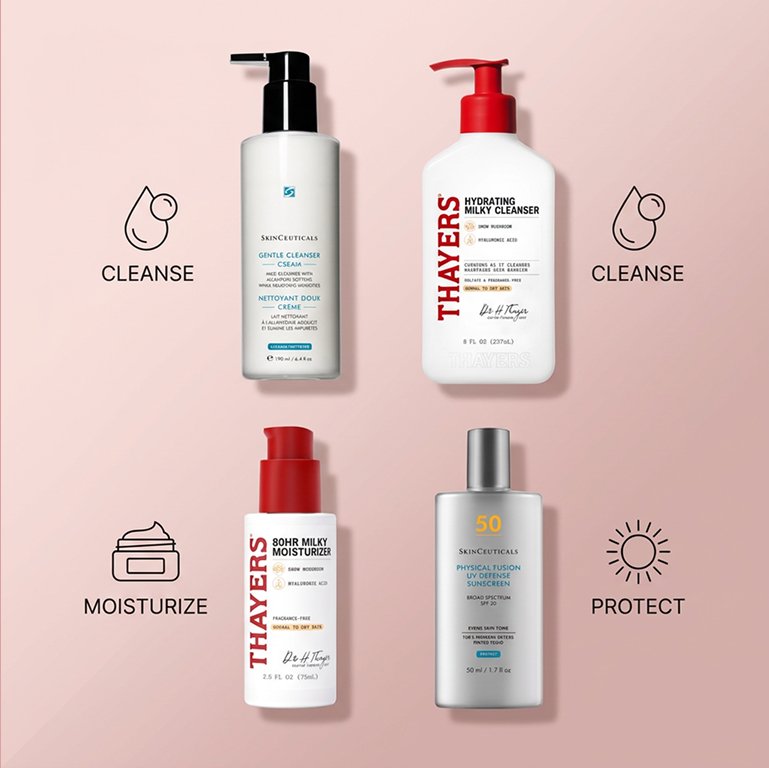
Opening Paragraph (40-60 words): Choose one cleanser, one moisturizer, and one daytime sunscreen from the options below. The comparison table summarizes each product’s routine role, benefit, and texture so you can select products without adding unnecessary steps.
| Product | Routine Role | Key Benefit | Texture |
| SkinCeuticals Gentle Cleanser | Gentle cleansing | Cleanses without compromising the skin's moisture barrier | Cream cleanser |
| SkinCeuticals Physical Fusion UV Defense SPF 50 | Daytime sun protection | Broad-spectrum mineral UV protection | Lightweight fluid |
| Thayers Milky Cleanser | Gentle cleansing | Supports a pared-back cleanse without adding an active step | Milky cleanser |
| Thayers Milky Moisturizer | Moisture support | Helps fill the moisturizer step in a simple reset routine | Milky moisturizer |
SkinCeuticals Gentle Cleanser for Gentle Cleansing
SkinCeuticals Gentle Cleanser is a cream cleanser formulated to remove impurities and makeup without compromising the skin’s moisture barrier. It can be used as the routine’s single gentle cleanser.
Key Ingredients: It is formulated with Allantoin, glycerin, and orange oil AND helps soften and condition the skin as it cleanses.
Who Can Use It: Dry, normal, or sensitivity-prone skin; anyone seeking a gentle cleanse.
SkinCeuticals Physical Fusion UV Defense SPF 50 for Daily Sun Protection
SkinCeuticals Physical Fusion UV Defense SPF 50 is a lightweight, broad-spectrum mineral sunscreen for the daytime protection step. Users should follow provider guidance after a procedure and choose sunscreen based on finish, compatibility, and comfort.
Key Ingredients: It is formulated with Zinc oxide and titanium dioxide AND provides mineral UV protection, while artemia salina extract AND helps support skin’s defenses against UV- and heat-induced stress.
Who Can Use It: All skin types, including those experiencing temporary sensitivity.
Thayers Milky Cleanser for Gentle Cleansing
Thayers Milky Cleanser is an alternative gentle cleanser for removing daily buildup without adding an exfoliating or treatment step. Use it instead of—not in addition to—another cleanser to keep the reset routine simple.
Key Ingredients: It is formulated with Snow mushroom, hyaluronic acid, and elderflower water AND helps hydrate and support skin comfort while cleansing.
Who Can Use It: Normal to dry skin, including sensitivity-prone skin; anyone seeking a gentle, non-stripping cleanser.
Thayers Milky Moisturizer for Moisture Support
Thayers Milky Moisturizer fills the reset routine’s moisturizer step, supporting skin hydration and consistency without functioning as another active treatment. Use it as the single moisturizer rather than layering several hydrating products
Key Ingredients: It is formulated with Glycerin, shea butter, sugarcane-derived squalane, cholesterol, and ceramides AND helps attract moisture, soften dry skin, and support skin comfort.
Who Can Use It: Normal to dry skin, including sensitive skin; anyone seeking lightweight, long-lasting moisture support.
How Do You Reintroduce Products After a Skincare Reset?
- Declutter and Assess: Remove overlapping actives and known irritants. Set aside strong actives/retinoids unless instructed by your dermatologist.
- Establish Your Reset: Stick with gentle cleanser, moisturizer, and SPF. There is no set duration for a skincare reset; instead, track skin comfort and function—fewer stinging episodes, less dryness, or reduced breakouts are progress markers.
- Reintroduce Products Slowly: Once skin feels stable, add products back one at a time. Watch for signs of irritation or sensitivity. Patch testing and symptom tracking can help you decide which products truly work for you.
A skincare reset is all about giving your complexion a clean slate—allowing you to identify what truly works for your skin and what doesn’t. By simplifying your routine and then slowly layering products back in, you can support a healthier, more resilient appearance while minimizing irritation and guesswork.
Step 1: Declutter and Assess Your Current Routine
Review your current products for overlapping active ingredients and potential irritants. Temporarily set aside strong actives such as retinoids, AHAs, and BHAs unless a clinician advises otherwise. Note any products that repeatedly cause discomfort or redness. Changing one variable at a time makes reactions and improvements easier to trace.
Step 2: Establish Your Core Reset Regimen
Use a minimalist skincare routine built around gentle cleansing, moisturizer, and daytime sun protection. There is no universal answer to how long a skincare reset should last, so monitor patterns in comfort and function instead of following a fixed deadline.
Useful signs of progress include less stinging after cleansing, reduced tightness, steadier hydration and oiliness, and fewer unpredictable reactions. Natural texture, visible pores, and occasional blemishes can remain even when the routine is working well.
Step 3: Gradually Reintroduce Products (If Needed)
Once skin feels consistently comfortable, reintroduce products one at a time and at a measured pace. This helps connect each addition to irritation, congestion, dryness, or improvement and supports a more sustainable routine. Seek professional guidance when ongoing sensitivity requires additional caution.
How Do You Maintain a Simple Routine After a Skincare Reset?
Keep the routine clear and sustainable: stick with what works, make changes gradually, and avoid product overload. This supports a lasting barrier-first approach and helps prevent future stress on your stratum corneum and lipid matrix.
What Else Can Affect Skin During a Reset?
External factors—weather, travel, stress, sleep, makeup removal, and contact with daily items—can affect your progress. Track what you can, but change only one factor at a time for clarity.
Skincare Reset FAQs
Should I stop using retinol during a skincare reset?
Pause retinol/retinoids during a reset unless advised otherwise. When reintroducing, start low and slow, separate from exfoliating acids.
Can a skincare reset help with blemishes from product overload?
A reset can clarify the cause when blemishes follow heavy layering or product switches—helping you spot congestion triggers.
When does sensitivity require a tailored reset?
Tailor your reset if you’re dealing with chronic sensitivity, prescription treatments, or post-procedure skin. Always keep prescribed elements in your routine.
Can I use makeup during a skincare reset?
Yes, if comfortable, but remove it gently. Oil-based removers can help if SPF or makeup residues remain.
What should I do if my skin feels worse during the reset?
Compare to your pre-reset baseline. Assess if you’ve cut something vital or missed gentle removal. Stop experiments and consult a board-certified dermatologist for persisting or worsening symptoms.
When a Skincare Reset Makes Sense
When your skin feels tight, reactive, overloaded, or unpredictable, a skincare reset offers clarity—not perfection. It’s about supporting your skin’s unique needs, not passing harsh judgment or chasing an unrealistic ideal. If symptoms are severe or lingering, always seek advice from a skincare professional.
Use a skincare reset as a tool—not a punishment. Simplify, assess, and let your skin recalibrate. Visit Skincare.com’s expert advice for more healthy skin tips or transition into a minimalist skinimalism routine when you’re ready to build back smarter.
This article reflects editorial research and brand formulation data. Product recommendations are based on ingredient analysis and brand claims.


Read more