
.jpg?cx=0.5&cy=0.5&cw=150&ch=120&blr=False&hash=32CFC9647F516D159375559BB5C39EFD)


.jpg?cx=0.490000009536743&cy=0.540000021457672&cw=150&ch=120&blr=False&hash=93ED4F6DFD0EB29BB2E466E6DDD7C794)













How to Support a Compromised Skin Barrier Without Overcomplicating Your Routine
October 09, 2026
.jpg?cx=0.5&cy=0.5&cw=400&ch=300&blr=False&hash=1434B427E9C7A0702ACC8A69DC99E94E)
Key Takeaways:
- For gentle cleansing, use a hydrating, pH-balanced cleanser formulated to cleanse without stripping natural oils.
Options: CeraVe Hydrating Facial Cleanser, La Roche-Posay Toleriane Hydrating Gentle Facial Cleanser - For hydration and moisture, seek moisturizers formulated with ceramides, a key component of a healthy skin barrier.
Options: SkinCeuticals Triple Lipid Restore 2:4:2, CeraVe Moisturizing Cream - For daily protection, a broad-spectrum sunscreen with SPF 30 or higher is essential for shielding the barrier from UV damage.
Options: La Roche-Posay Anthelios Melt-In Milk SPF 60, SkinCeuticals Physical Fusion UV Defense SPF 50
If your skincare routine suddenly feels like it's working against you, you're not alone. Skin that stings, feels tight after cleansing, or becomes increasingly reactive often signals that your skin barrier needs extra support—not necessarily more products.
Supporting your skin barrier often starts with doing less, not adding more. A streamlined, simple skincare routine built around gentle cleansing, effective moisturizing, and daily sun protection can help limit potential irritants, maintain hydration, and support healthy barrier function while you identify which products your skin truly tolerates.
What Is the Skin Barrier, and Why Is It Important?
Think of your skin barrier, or stratum corneum, as a brick-and-mortar wall. The skin cells are the "bricks," and lipids—fats like ceramides, cholesterol, and fatty acids—are the "mortar" holding them together. This wall has two critical jobs for skin health and appearance.
The Two Main Functions of the Skin Barrier
- It Keeps the Good Stuff In: The primary function is preventing transepidermal water loss (TEWL). A healthy barrier locks in moisture, keeping skin hydrated and supple—so skin feels soft and comfortable.
- It Keeps the Bad Stuff Out: The skin barrier acts as the body's frontline defense, protecting skin from external aggressors like pollution, allergens, and bacteria, which can trigger irritation and sensitivity.
How to Tell if Your Skin Barrier Needs More Support
A damaged or compromised skin barrier typically shows up as moisturizer that suddenly stings, tightness after cleansing, persistent redness, itching, rough or flaky texture, or products that used to work becoming irritating. For some, congestion can develop after adding too many repair products, or skin feels oily and dry at once. Because these symptoms overlap with other skin concerns, monitor how your skin responds over time—not just to a single product.
How to Build a Routine That Supports Your Skin Barrier
Begin by pausing all exfoliating acids, retinoids, scrubs, fragranced products, and harsh cleansers. Keep only the essentials your skin tolerates: a gentle facial cleanser, a barrier-supportive moisturizer (with ceramides for skin), and broad-spectrum daily SPF. Treat hydrating serums—notably those with hyaluronic acid—as optional, and only reintroduce active ingredients one at a time after skin feels calm.
| Step | What You Can Do | Product Options |
| Step 1: Cleanse Without Stripping Natural Oils | Choose a gentle facial cleanser that is hydrating, pH-balanced, and fragrance-free. Use lukewarm water, clean gently with fingers, and pat dry. | |
| Step 2: Add Hydration Before Locking It In | Hydrating serums with ingredients such as hyaluronic acid or niacinamide attract water to the skin and can improve comfort and suppleness. | |
| Step 3: Replenish Moisture With Barrier-Supportive Ingredients | Apply a ceramide-rich moisturizer. Ceramides support the skin barrier by helping lock in hydration while helping to fortify the mortar between skin cells for a supple texture. | |
| Step 4: Protect Your Progress Every Morning | UV rays stress the skin barrier, so daily broad-spectrum sunscreen of SPF 30 or higher is a must. |
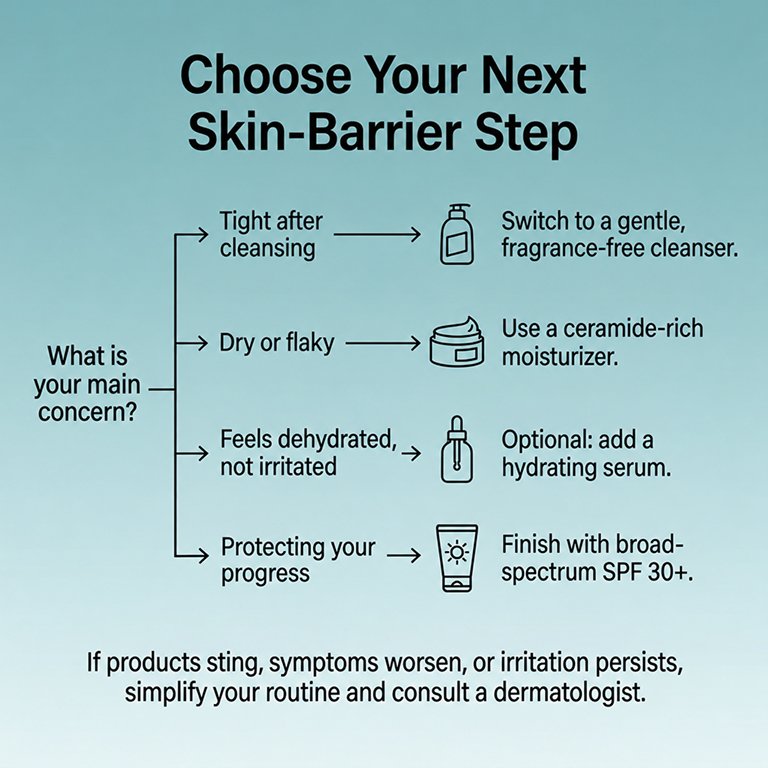
If you're feeling overwhelmed by advice, adopting a minimalist skincare routine can be one of the most effective strategies to reduce irritation while supporting a compromised skin barrier. By focusing only on gentle cleansing, a ceramide-rich moisturizer, and daily SPF, you give your skin space to recover with fewer potential triggers.
Common Skin Barrier Concerns and How to Choose Barrier-Supportive Products
- Moisturizer stings or burns: This can indicate reactive skin or sensitivity to fragrance/actives. Pause and switch to a fragrance-free moisturizer, patch test before full use.
- Skin feels tight after cleansing: Your cleanser may be stripping or water too hot. Switch to a gentler cleanser, use lukewarm water, and cleanse less often.
- Breakouts or congestion: Cream may be too rich. Swap for a lighter lotion with ingredients like ceramides, glycerin, panthenol, or squalane.
- Sunscreen burns: Test a sensitive-skin SPF formula and always patch test.
- Redness after using an occlusive: The layer may be too heavy or trapping heat. Use sparingly on dry patches.
- No improvement or worsening symptoms: Other triggers or skin conditions may be at play. See a dermatologist if symptoms persist or worsen.
If you struggle with ongoing dryness or flaking alongside sensitivity, shifting to a skincare routine for dry skin that is both gentle and barrier-supportive is key. Look for formulas that prioritize emollients and avoid common irritants to help restore comfort and resilience to parched, tight skin.
How Long Does It Take for a Compromised Skin Barrier to Improve?
Mild irritation often improves within a few weeks after simplifying to a simple skincare routine. However, recovery time varies depending on severity and cause. Track burning, tightness, redness, and flaking—and avoid constantly changing products, as this can make it hard to spot irritants and boosters.
FAQ - Skin Barrier Routine Questions Answered
What are the signs of a damaged skin barrier?
A damaged skin barrier presents as redness, sensitivity, burning, tightness, or unusual dryness/flakiness. Increased reactivity to products is common, as moisture escapes more easily and irritants penetrate faster.
Should I use exfoliants if I'm trying to support my skin barrier?
It’s wise to pause all exfoliants—both physical scrubs and chemical acids—when your barrier is compromised. Over-exfoliation is a frequent cause of damage. Once skin is calm, introduce gentle exfoliants just once or twice weekly.
Should I stop all skincare if my barrier is damaged?
No. Simplify, don’t eliminate. Use a gentle cleanser, fragrance-free moisturizer, and daily SPF. Pause exfoliating acids, retinoids, scrubs, and anything that stings. If even basic products give persistent burning, see a dermatologist.
Why does my moisturizer burn when my skin barrier is damaged?
A weakened barrier lets ingredients reach deeper, sensitive layers, causing stinging. Switch to a minimalist, fragrance-free formula and patch test. Persistent issues may signal an allergy or other skin problem needing medical advice.
What should I stop using first if my skin barrier feels compromised?
Stop products likely to irritate: retinoids, exfoliating acids, scrubs, benzoyl peroxide, fragrant products, and harsh cleansers. Keep only a gentle cleanser, basic moisturizer, and SPF. If cleansing hurts, swap cleansers before adding more.
Simple Habits That Help Support Your Skin Barrier
A consistent routine with gentle cleansing, hydration, moisturizing, and daily SPF is your best ally for a resilient skin barrier. Rather than constantly experimenting, stick to the essentials for balanced, healthy skin.
Now that you have your routine down, learn more about the key ingredients that can help. Read our guide to starting a skin care routine.
Editorial Disclosure: Product selections are made using editorial research and brand knowledge; personal use or testimonials are noted where applicable.


Read more